
Coaching: Referee the Listening
who is getting ignored? who is adjusting?


Coaching is less about you delivering improv wisdom and more about being a good administrator. Get the practice started. Pick the exercises. Find out what the group wants and if they want different things, suggest a compromise.
Here’s another job the coach can do that can save teams: referee the listening.
Point out when folks do not notice things. Point out when folks communicate things in a confusing way. And on the other side of the balance sheet, point out when someone makes a big adjustment in order to say yes.
I Was Not Listened To
One of the most common complaints from people is “I was not listened to.” It can ruin teams. Be the coach who gently calls it out.
This is especially crucial at the top of scenes. The most common time for people to simply not notice each other is right at the top. Everyone is processing the suggestion or the opening and they are simply not paying any attention to each other.
But the coach should see it.
Did You Notice?
Stop the scene early. I like the phrase “did you notice.”
“Did you notice that this person is acting like they’re your boss and you called them honey?”
“Did you notice that the suggestion was ‘sandwich’ and they were over here doing what looks like making a sandwich and you called them a witch?”
It doesn’t mean the scene could not have been good. Misunderstandings lead to really fun choices.
But a team will lose trust in itself if they don’t really really listen to each other.
It’s Just The Facts
A nice thing about calling this out: almost no one argues. If you tell someone their choice wasn’t grounded, they’ll argue that it was grounded until they die.
But if you say “it looks like they were making a sandwich and you called them a witch” they will at the very least look at the other person and say “I’m sorry, I missed that.”
Becuase you’re not saying the scene was bad. You’re not saying the choice was bad. You’re simply asking “Hey did you notice this thing?”
It’s also good of the coach to notice the good listening. When someone accepts a surprising offer. When someone is able to adjust. Compliment it. Those moments don’t always get a laugh, so they could use your validation.
Qualification
Please assume this entire essay has me also saying “to the best of my knowledge” and “when I’m doing my job right I do this but I don’t always do it.”
Tell me if you think I’m way off in my advice, please! Or suggest a better way to do what I’m talking about.
End of Essay. Commence plugs.
Comedy Bang Bang
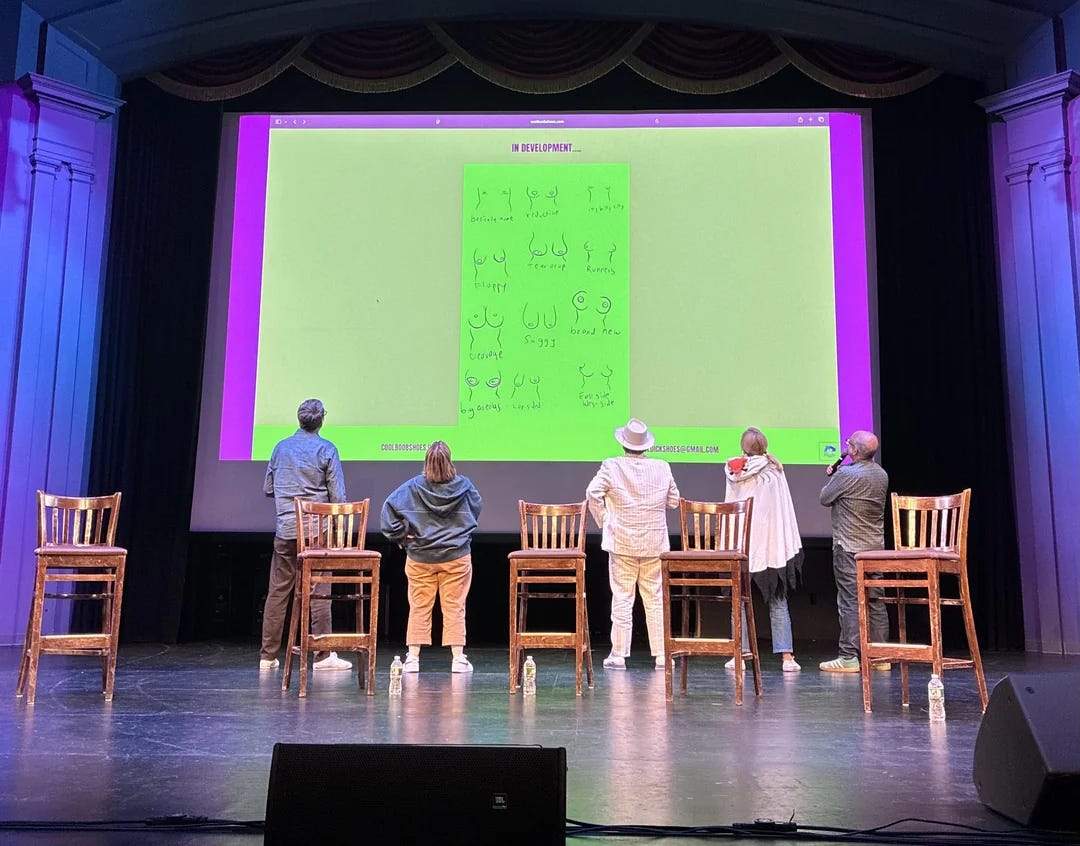
I got to do a few live shows with the podcast Comedy Bang Bang last week. The audio of these episodes is available behind their paywall.
If you don’t know it, CBB is an improvised talk show hosted by Scott Aukerman. The live shows always feature genius comedian/professional nice man Paul F. Tompkins as a guest, and then a few other CBB regulars join them. I did shows with Erin Keif (Hey Riddle Riddle), Anna Bezhauler (UCB, Anna and Isabella), Ryan Gaul and ALMOST Connor Ratliff (postponed Boston show).
Standard Plugs
The World’s Greatest Improv School: The improv school I run with Jim Woods and Sarah Claspell. We’ve got classes online, in LA and even a few in NYC! You can join our mailing list if you want our weekly announcement of shows.
World’s Greatest Improv (YouTube channel): My improv theater is beginning to stream shows. Subscribe to watch! It’s all free!
How to Be The Greatest Improviser On Earth - My improv book, available at Amazon. Kindle or print (also on my web site for more if you don’t want to buy from Amazon). It’s a hodge-podge of advice I wrote in 2016 about doing improv. If you’re short of funds and want a free PDF version just email me and I’ll send it over.
I like when you drop gems like these the day before I have to coach so I can steal everything. My guys are probably sick of me qualifying everything with "so I read this in Will's substack!!!"
A few years ago I got a soccer coaching certification and one of the concepts I learned there gave me a different approach to this problem. The idea is when someone wants to perform an action (in soccer - pass to another player, in improv - say a line) they go through 3 steps - perception, decision, execution. If something doesn't work you can see if it fits in one of those categories. Perception - did they listen? Did they see the object work? Did they see a subtle facial expression?. Decision - what decision did they make with that information? Did it match the pattern everyone else was laying down? Was it a fun choice? Was it complicated?. And Execution - did they say what they meant to convey? Did they do the object work clearly? etc. I find it helps narrow in on what needs improvement.